
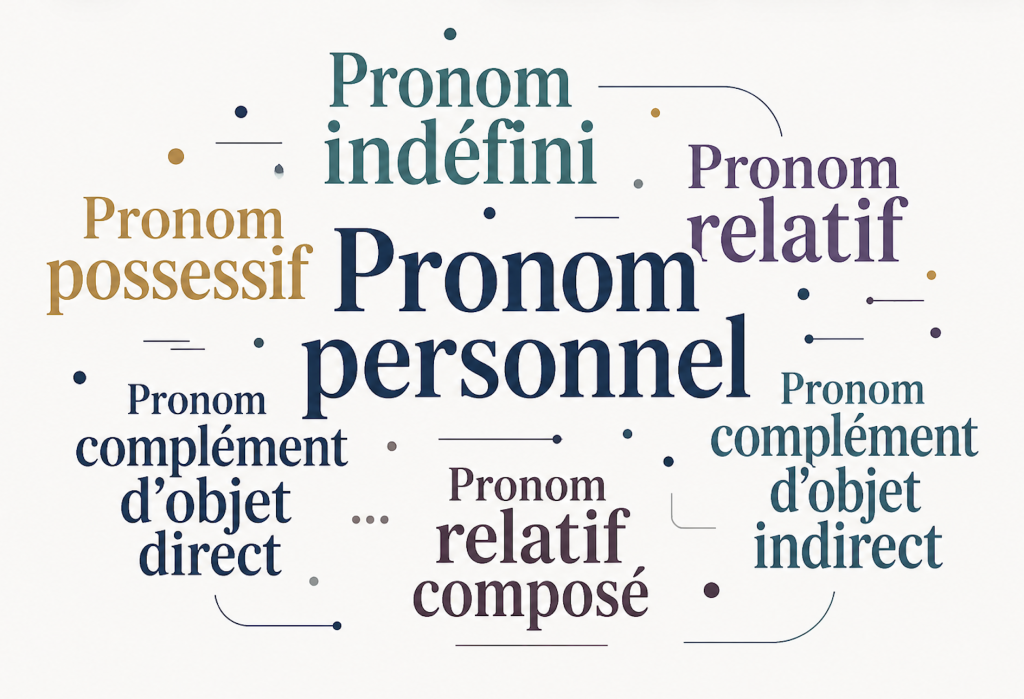
When we speak French in everyday life, we use pronouns without even realizing it. Yet these small words are essential to avoid repetition and make our sentences flow more naturally. Here is a simple and practical overview of the main types of pronouns, with concrete examples.
- Personal pronouns
Personal pronouns replace a person or a thing in a sentence.
Exemples :
- Je vais au travail.
- Tu arrives bientôt ?
They are essential in almost every sentence!
- Direct object pronouns (COD)
They replace a direct object, without a preposition.
Exemples :
- Tu vois Marie ? → Oui, je la vois.
- J’achète du pain → Je l’achète.
- Indirect object pronouns (COI)
They replace an object introduced by a preposition (often “à”).
Exemples :
- Je parle à Paul → Je lui parle.
- Tu écris à tes amis → Tu leur écris.
- Possessive pronouns
They indicate possession.
Exemples :
- Ce livre est le mien.
- Cette voiture est la sienne.
Useful to avoid repeating “mon livre”, “sa voiture”, etc.
- Relative pronouns
They are used to connect two clauses.
Exemples :
- Le film que je regarde est intéressant.
- La personne qui parle est mon voisin.
- Compound relative pronouns
A bit more formal, they include forms such as lequel, laquelle, auxquels, etc.
Exemples :
- La chaise sur laquelle je suis assis est confortable.
- Les projets auxquels je pense sont importants.
- Indefinite pronouns
They refer to people or things in a vague or unspecified way.
Exemples :
- Quelqu’un a frappé à la porte.
- Rien ne fonctionne aujourd’hui !
In summary
Pronouns are everywhere in the French language. Whether you say je te parle, le livre que j’ai lu, or quelqu’un arrive, they make sentences more natural and pleasant to hear.
👉 Tip: practice using them in your daily conversations. The more you use them, the more natural they become!
Your turn now!